Tuesday, June 1, 2021

Railroad Baggage Wagons Photo Info


1925 Melbourne Avenue, Logansport, Indiana 

The camera was on the south side of the tracks looking to the north, between 4th and 5th streets, on Melbourne Avenue. Circa 1925.


This scene was common about midday, any day, and midnight when through trains reached Logansport. While the baggage trucks had lined up for this photo, there was nothing unusual about their number or the amount of express items ready for shipping. In fact, there were days when a larger amount could be found, being transferred from one train to another at the 4th street (Pennsylvania) depot, just out of camera range to the left.


The three buildings facing the camera were all undoubtedly there before the railroad tracks were which was prior to 1860. Canal Street, as Melbourne was called then, was covered with nice homes – on both sides of the street – all the way from the confluence of the rivers to 14th  or 15th Street. The coming of the railroad spoiled it as a residential street.


In this photo: the two houses at the left no doubt were built as residences.

   The weather boarded frame at the extreme left had been the home of Earl Stewart, who owned a livery stable just around the corner on 4th…out of the picture. (There were several stables around town at that time and Stewarts was considered one of high class. Nicest cabs for rent, fastest horses and most stylist drivers to take the customer wherever they wanted to go.) In later years the railroad used rooms in the house for ticketing, and the U.S. Railway Mail used some space for sorting mail. The railroad company equipped the place with showers and reading rooms and put a secretary in charge and made it available to its trainmen. Three of those secretaries were: a man named Davidson, a man named Nelson W. Benning, and a man named Pendleton.


   The building at the right in 1888 was used by a man named Otto Meinshausen whose business was metal roofing. His main store was around 4th and Market; this was more of a shop and storehouse. The porch wasn’t on it at that time but was added later. After that this property had several uses – interestingly it had at one time been the site of Logansport’s Colored School of which Thomas J. Legg was the principal. (It seems that a colored school had been in operation as early as 1871 on the SE corner of Heath and W. Market. The date of this one would’ve been about 1881.)


   The building in the middle after 1888 was by the railroad company for the use of its passenger trainmen who might have difficulty finding rooms with bathing facilities. (Considered to be the first form of a YMCA.)


Wednesday, April 28, 2021

Cass County Indiana Court Park

 May 15, 1920 Logansport Pharos Tribune Court Park Undergoing Many Changes

Court Park adjacent to the Cass County courthouse and county jail is being placed in conditions in preparation for summer visitors. William Gasho, park custodian, states that during the last few years a great change in the character of the visitor to the park has been noticed. Where once the town bum loafed in the park now women with their small children are visitors and the working man brings his family after the evening meal to spend an hour or two. The fountain is being refurbished, including a curbing that is being placed under the iron fence that surrounds it. The fern bed surrounding the pool is filling in nicely. All of the benches have been freshly painted and secured to the ground


Court Park was located on the west side or in back of the Cass County Courthouse; on Third Street. The area now serves as parking for the new courthouse.


The photo above shows the Civil War memorial cannon, the fountain, and the west (or back side) of the Cass County courthouse, on Third Street. The fountain now stands in Heritage Park on E. Market Street, Logansport. The cannon is still displayed next to the courthouse.


Above: Cass County courthouse; photo date 1892. This was the east side or the front side, facing Fourth Street.

The courthouse was razed in 1979 and a new one built in its place.

Saturday, April 3, 2021

Edwin Rutenber & Western Motor Company


In 1900 a new industry came to Logansport, Indiana and opened a new foundry on the west side, at the west end of Wheatland Avenue at Center Street and Western Avenue. It was known as the Logansport Foundry Company. A year or two later, two men who had been living in Chicago came to the new foundry. They were Edwin A. Rutenber and Henry D. Rutenber.

Ed was a clever designer and had invented a new multi-cylinder motor. Henry, his older brother, was a skilled pattern maker and made patterns for his brother's designs. The new motor became so popular that the foundry firm was re-organized and became the Western Motor Company.


The Western Foundry buildings in, Logansport, Indiana photo dated 1916


The Rutenbers and James F. Digan, the practical foundry man of the company, developed a method of casting a four-cylinder motor in one piece or "en bloc", to use a technical term. It became immensely popular.

Ed Rutenber wanted to build complete automobiles. He enlisted the help of two Logansport men - Lem Coppock and Charles S. Ferguson. The two men, working in Ferguson's barn, produced a car that ran satisfactorily. The hish body reaching fully six feet above the ground had no top. And, no one knew how fast it would run, because speedometers weren't made at that time.

The high body style wasn't new. In fact it was the popular style of the day and there were many cars of that type in town.

Rutenber and Coppock used a four-cylinder standard Rutenber motor for the car. Joe Amen, a local carriage maker, built the body. The group had ambitious plans for the establishment of a company to manufacture cars on a large scale, but those plans never materialized.

During the summer of 1902 the firm produced 10 automobiles. One of those was known to have been designed for C. W. Swift of the famous Chicago meat packing house. 

It was Rutenber's first and last series of automobiles. The comapny did, however, become famous as an engine builder.

In 1973, the Smithsonian Institution, United States National Museum, in Washington D.C., accepted a Rutenber engine into its collection, with the understanding by descendants of the Rutenber family that the engine might not be on display, but would be properly preserved and stored. (Copies of the correspondence between the Smithsonian and the Rutenber relatives are included in the Cass County Historical Society archives.)

Edwin Aubert Rutenber died in 1962, in Greenville, Michigan. He is buried there - in Forest Home Cemetery. His wife, Lorayne rests next to him.


The Rutenber home aka the "Rutenber Mansion" still stands on the NE corner of Helm Street and Park Avenue in Logansport, Indiana. 2021 photo - credit Jerry Wolfe.

Monday, March 29, 2021

The A. L. Jones Building 417 North Street


March 13, 1916 Logansport Reporter, Page 1

A. L. JONES TO BUILD LATEST STYLE APARTMENT BUILDING

Spring building operations in Logansport received another big boost today when A, L. Jones of the Northern Realty Company announced that within a few days he would begin the erection of a $30,000 strictly modern flat building at No. 417 North street. The building will be constructed of brick, three stories in height and will contain six flats of five rooms each.

And when Mr. Jones says, modern, be means that in the strictest sense of the word, for the, new building will be fashioned after the very best apartment houses erected in California.

Each flat will have a sun parlor, there will be a generous supply of disappearing beds, and either there will be ice boxes built in the walls or there will be a refrigerating plant; there will be an electric elevator, a billiard parlor in the basement, city heat with an independent steam heating plant for use in emergencies and in fact everything will conform to the latent idea of apartment house building.

Mr. Jones was not in a position today to state what rental rates would be in the new building, but he did vouch safe the information that they, would be high, However, he declared that the price apparently did not cut much figure with a number of local, people, as several have stated to him that they would take flats in the building, seeming willing to pay the price if all the modern conveniences are to be supplied. Architect Carl Horn prepared the plans.

 The building owners in recent years were Judge Julian and Susanne Ridlen. The current owner is Susanne Ridlen. Julian passed away in 2017.

When I was still the Executive Director for the Cass County Historical Society I wrote a story and shared the above news article with the membership, in the newsletter. That was a few years ago. Judge Ridlen was still living and after reading the newsletter he sent me the following note:

Judge Julian Ridlen 1940-2017


Thelma,

Thank you very much for the article and photo re: The A. L. Jones / Commerce, and now, Ridlen Building. 

A few noteworthy additions to the Jones article:

  • Each apartment had a voice tube between it and the mailbox unit in the foyer.
  • Jones purportedly was the patent owner of the in-a-door beds that were installed -- three in each unit.
  • Each unit had a pantry with window facing on the rear service stairs. Residents could place their order card for ice in the window, and the ice man could provide ice to the ice box without entering the apartment.
  • Finish woodwork was entirely in butternut wood.
  • Though windows could be opened in pre air conditioning days, each unit had a natural external air system that could be utilized to provide fresh air circulation.
  • Though the elevator operation system has been modernized to meet all requirements, the classical cage and appearance has been maintained.

Thanks again for the article for our archives.


Best regards,

Julian


Saturday, February 20, 2021

The Mall - Logansport Indiana

 Built in 1967 - May 26, 1967 clipping from the Logansport Pharos Tribune and Press, page 1


Photo of the Logansport Mall Sign taken in 1977


List of merchants in a 1977 promotional ad


 Just as in any other city, the shopping mall was the place to go for so many reasons, not just shopping. It was a place to see people, have a snack or a sandwich, play acarde games or just get a little exercise by walking laps inside the place.

It was a place to go to get into the holiday spirit, with it's beautiful Christmas tree(s) and lights and decor and Santa's Sleigh and big, comfy chair to greet everyone.

Saturdays were perfect for kids at the mall to hang out. Parents could drop off car loads of their kids and their kids' friends for a couple of hours, much to the chagrin of the mall employees, who resented being made to feel like they had to be responsible "babysitters" for "other people's kids".

So much happened at the local mall. Car shows, coin shows, musical programs, charity auctions, and oh yeah - shopping. Side walk sales were a seasonal thing. Merchants, especailly Sears and J C Penney - the anchor stores - would fill the center aisle of the mall property with racks and tables filled with clothing, shoes and any item sold at any of the stores - all offered at great discounted prices.

During Christmas shopping season, "Black Friday" to Christmas Eve, that center floor space would be filled with seasonal vendors who sold everything from hats to tee shirts to perfumes, candy and Hickory Farms products, to sunglasses.

February 1996 - Twelve Vacancies

Cocerns expressed at a meeting of the Logansport Economic Development Foundation board about vacancies in the mall were published in the Logansport Pharos Tribune. The article was on page 1, February 23, 1996. Terry Alley, Mall manager at that time, confirmed that the property was for sale and that prospective buyers had been looking at it for months. Within the article Alley was quoted, "I'm very optimistic. I think that it (a sale) will happen very soon." and "I think its going to be for the better - a real improvement".
Alley also explained that of the stores that had left the mall, some didn't renew leases as ordered by their corporate managers, but most of the vacancies were due to national chains going bankrupt and other chains just closed their doors.

March 18 1996 - Pharos Tribune


August 1996

The announcement that the mall now had nine vacancies instead of twelve and the opening of a fashion store called Stage was encouraging. (Below is an excerpt from the article. Pharos Tribune August 11, page 1.)


Two Mall Managers were arrested, at different times, for theft. Deedee Blume was hired as manager in 1998.

2003


On September 24, 2003 the Pharos Tribune page 1 headline read "Former Mall Manager Charged With Theft". Above is a clipping of the sub headline.


April 9, 2004, Pharos Tribune, page 1

Lynda Warner became Interim Manager in 2003 after Blume's arrest. Ironically, Warner was, herself, arrested for theft in 2009.

2009

June 4, 2009 Pharos Tribune, page 1


Store spaces began to empty in the mid to late 1990s. By July 12, 2015 the public was being asked for ideas for the Mall property. Below: clip from Pharos Tribune July 12, 2015.


This story is not finished. It is history in the making.


The fountain at the main entrance.


Saturday, February 13, 2021

Eli Greensfelder and the Greensfelder Building

 Eli Greensfelder was born in 1848. He came from Fort Wayne, Indiana to Logansport, Indiana in 1872 where he worked with a man named Martin Frank. They were in the clothing business.

After just one year with Mr. Frank, Eli went into business for himself when he bought the "Eagle Clothing House" from Wolfhelm and Schoenberg, at 315 E. Market Street. He retained the Eagle Clothing House name until the 1913 flood. Eli remained there until he died in 1918, at the age of 69.

Twin sons, Melvin and Herbert Greensfelder worked with their father and carried on the family business under the name Greensfelder Brothers.

Eli was very active in his community and a member of several service clubs, the Cass County Country Club and the local Cahmber of Commerce. He also served as the president of the Jewish Cemetery Association.


315 E. Market Street, Logansport, Indiana 

In 1953 Cass Historian Will Ball wrote "The modern, up-to-date store the Greensfelder brothers manage is the oldest in town to have been owned by the same family, and located in the same spot, for so many years".

Eli bought the store in 1880. The sons bought the room (313 E. Market) west of the original store in 1922. At that time the building had three stories. The brothers had the top floor removed.

The store was managed by the Greensfelder brothers except for the time the pair spent serving in WWI. Their sister, Florence, managed the store until their return.


above: Melvin Greensfelder during flood of 1936.

Above: E. Market during flood of 1943 - Greensfelder building is in the line of buildings.


Photos of the interior of the store during its heyday.

Melvin Greensfelder died in 1975.
Herbert Greensfelder died in 1977.
The Greensfelder Brothers store went out of business in 1983.


The address/building became home to a franchise business, which covered five counties, called The Box Shoppe, in in January of 1991. This company sold shipping supplies, boxes, etc. and offered UPS shipping services.

In 1992 Richard and Judy Rolewicz purchased the business from Janice Baldwin.

By 2003 the Rolewicz's were offering the building at 315 E. Market for sale.


March 19, 2003 Logansport Pharos Tribune


The City co-operated with Indiana Landmarks to try to save the building. And, it all seemed very successful. However, another issue arose and a portion of the back end of the building gave way.

After an inside and outside remodel the building was offered for sale. It even had a buyer. However another protion began to crumble and the building was torn down.


Thursday, September 10, 2020

Logansport and The 1913 Flood

 So, I compiled a book titled "Rain and River" for the Cass Co. Historical Society, using photos - post card images taken by the 4 photography studios in town at the time of the event - and material, such as eye witness accounts and newspaper accounts saved within the collection.

I ran across the folder, containing those images used in that book, on my computer screen today. I decided to share some of the good images here. There are many, many, MANY more - too many to share here. But I believe this is a good sampling. I hope you will agree.

The flood hit the mid-west. Logansport's disaster date was March 21, 1913. I will include an account that I wrote for the Cass County Historical Society, back in about 2006. 

Third Street Bridge over the Wabash looking north toward town from Biddle Island.

Same view after the bridge is swept away.

Same view, different angle, bridge swept away, but water now subsiding.


View from Biddle Island, notice the snow on the roofline. Yes, after the water rose and flooded the area, Mother Nature decided to add a little snow.


The yellow line was drawn on this postcard image to show just how high the 
water was before finally subsiding.


Above is the back of that postcard, explaining the drawn line.

Above and below - homes on Logansport's south/southwest side. 
The area known as "Shultztown" was hit the hardest.

People were cutting holes in their ceilings to access their roof where
they'd call out for help. Some even fired guns to get rescuers' attention.


"Naval Students from Chicago" rescue boat on west side of Logansport.
The larger group of rescue boats came from Culver Academy, about 45
miles north of Logansport in Culver, Indiana.


Here is a "Culver" boat. At the time I compiled the book I was told that boat 
No. 13 was still around. These young men of Culver Academy could
rescue because they had been taught the skills and the discipline required to do so.


Swirling flood waters on E. Market Street.


The image above was also published in the photo book "Where Two Rivers Meet",
another long-time best seller book by the CCHS.


Above photo was taken on E. Market Street.


The photo above was taken standing (or boating) on E. Market and 4th, looking
south toward the Pennsylvania RR Depot. The depot was torn down in the 1960s.


E. Market and 4th Street.


4th Street looking north. The courthouse is at left as indicated with text, the
former Masonic Temple (still stands and is apartments).


The Barnett Hotel stood in the 200 block of E. Market. It was the "new" Barnett
and shouldn't be confused with the original "old" Barnett, which stood on
the other side of the street on the southwest corner of 3rd and E. Market.
Notice the people on the upper balconies.


Above photo shows damage inside a downtown business, as the water is subsiding.


West side homes.

Train at the Pennsylvania Depot.


Interurban tracks, washed into the river.

This was taken after the waters subsided.
The back, or south side, of the Pennsylvania Depot is at right (above). 
The small building at left was washed down from upstream.


Melbourne St. at 5th St. looking west. Amelio's (now called Amelio's By The River) 
can be seen on the corner. The business displays the high water mark to this day.


Accessing the damage and in awe of what happened - these people stand at E. Market and 5th.


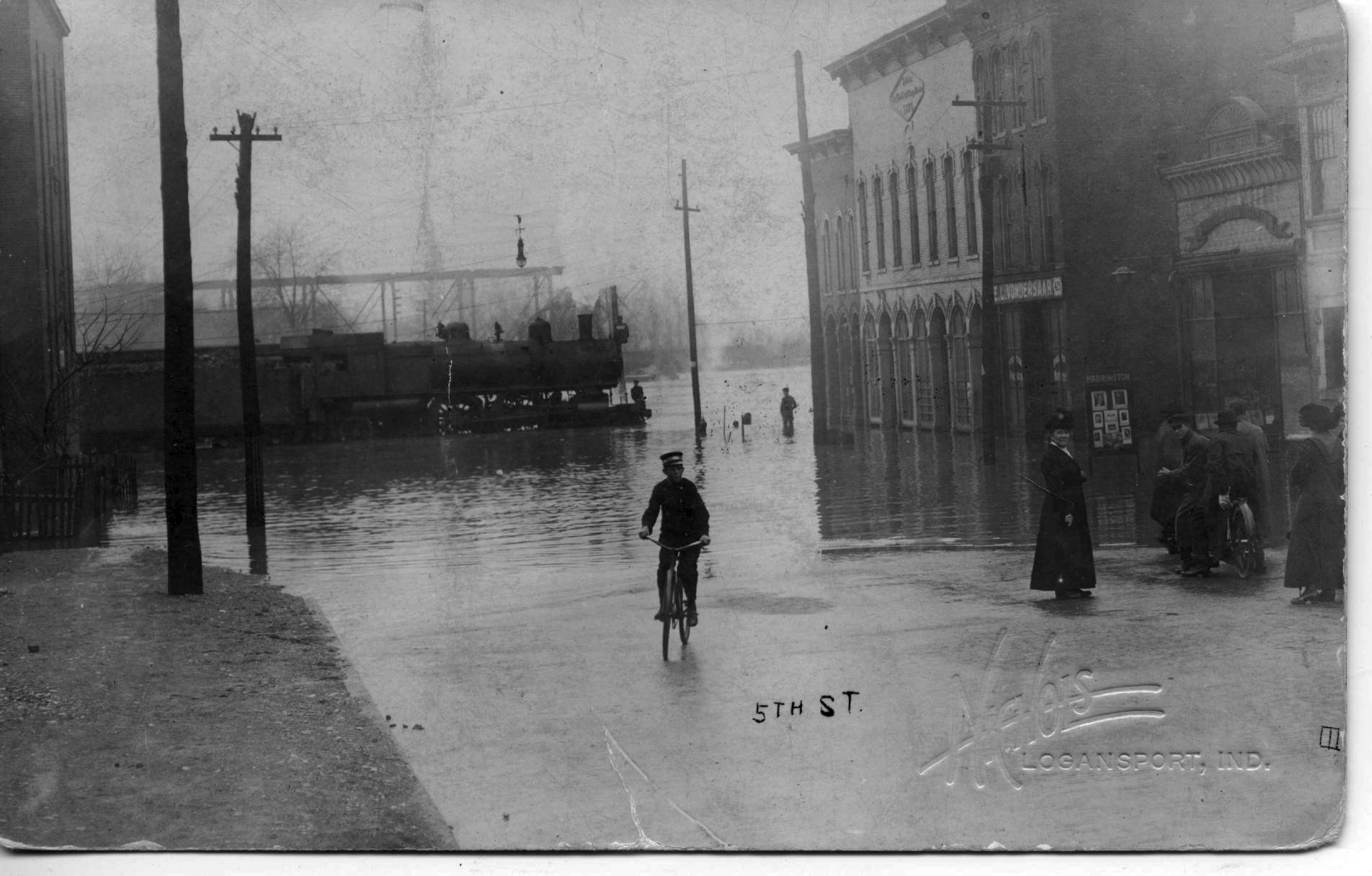
People stand outside Harrington Photography studio on 5th Street.


This is the entire photo from which the above was cropped. 
Fifth Street, near the RR tracks.


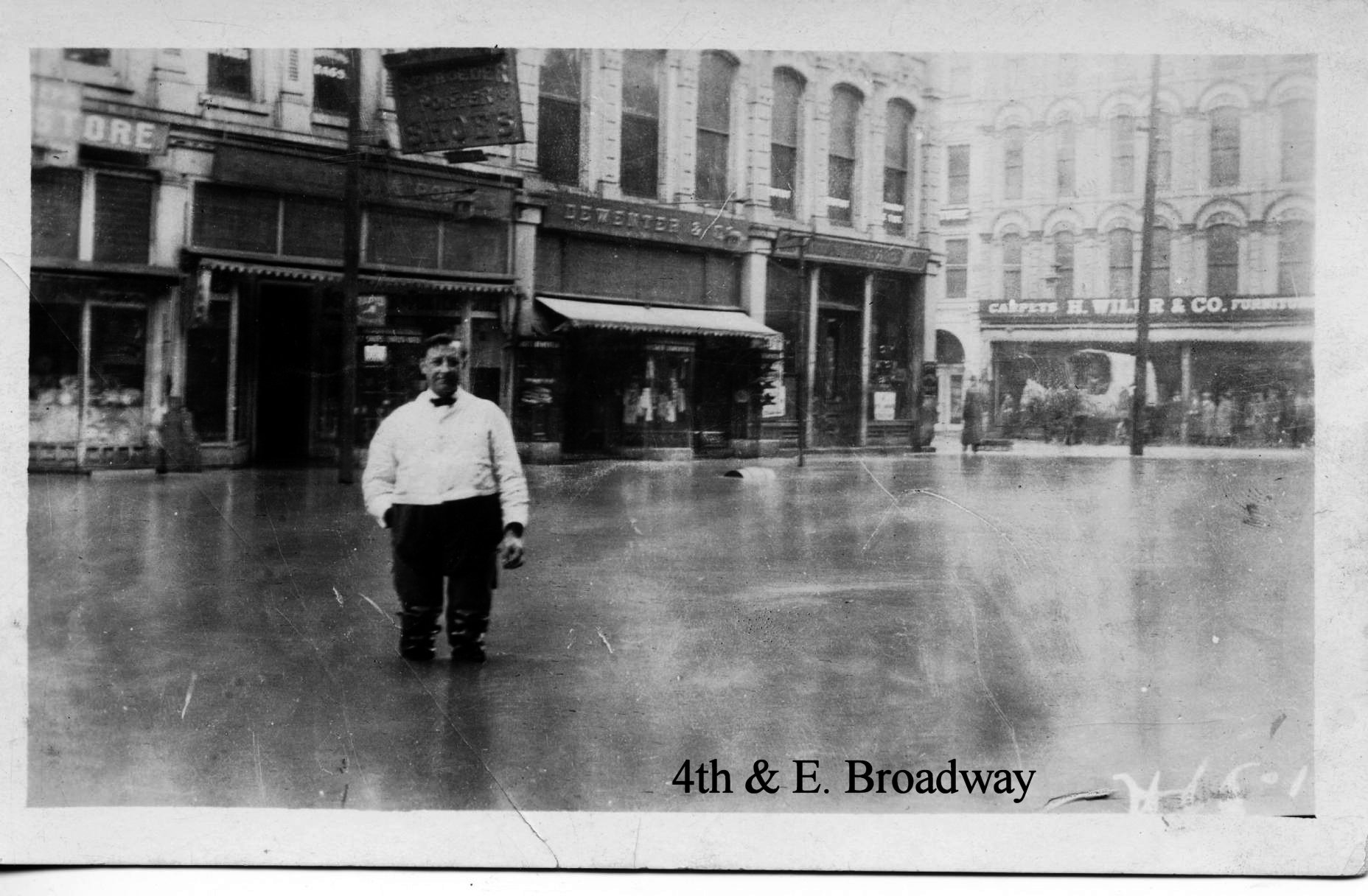
Corner of 4th and E. Market - the northwest corner. Note that a rope 
has been stretched for holding onto so one won't get swept away.


E. Market Street


At a glance one would think this was a rescue photo. I did,
 until a grandson (Evert Wolfe) of one of the boys pictured here on the back of the wagon
told me that this was more of a "tour group". 
They were riding around to see the flood!


This photo was taken on Logansport's west side. It shows the original
Franklin elementary school, which was torn down and a new, modern school built.


Above: at that time North Street went all of the way through to 3rd Street. That block was closed off when the new Cass County Jail was built, so younger generations will not recognize the area.


After...


Downtown merchants tossed damaged goods and furnishings to the street.

For more information go to the Cass County Historical Society web page at casscountyhistory.org you can also do a search for the 1913 flood in Indiana. You could also purchase the book Rain and River through the Cass County Historical Society - all sales benefit the Society.